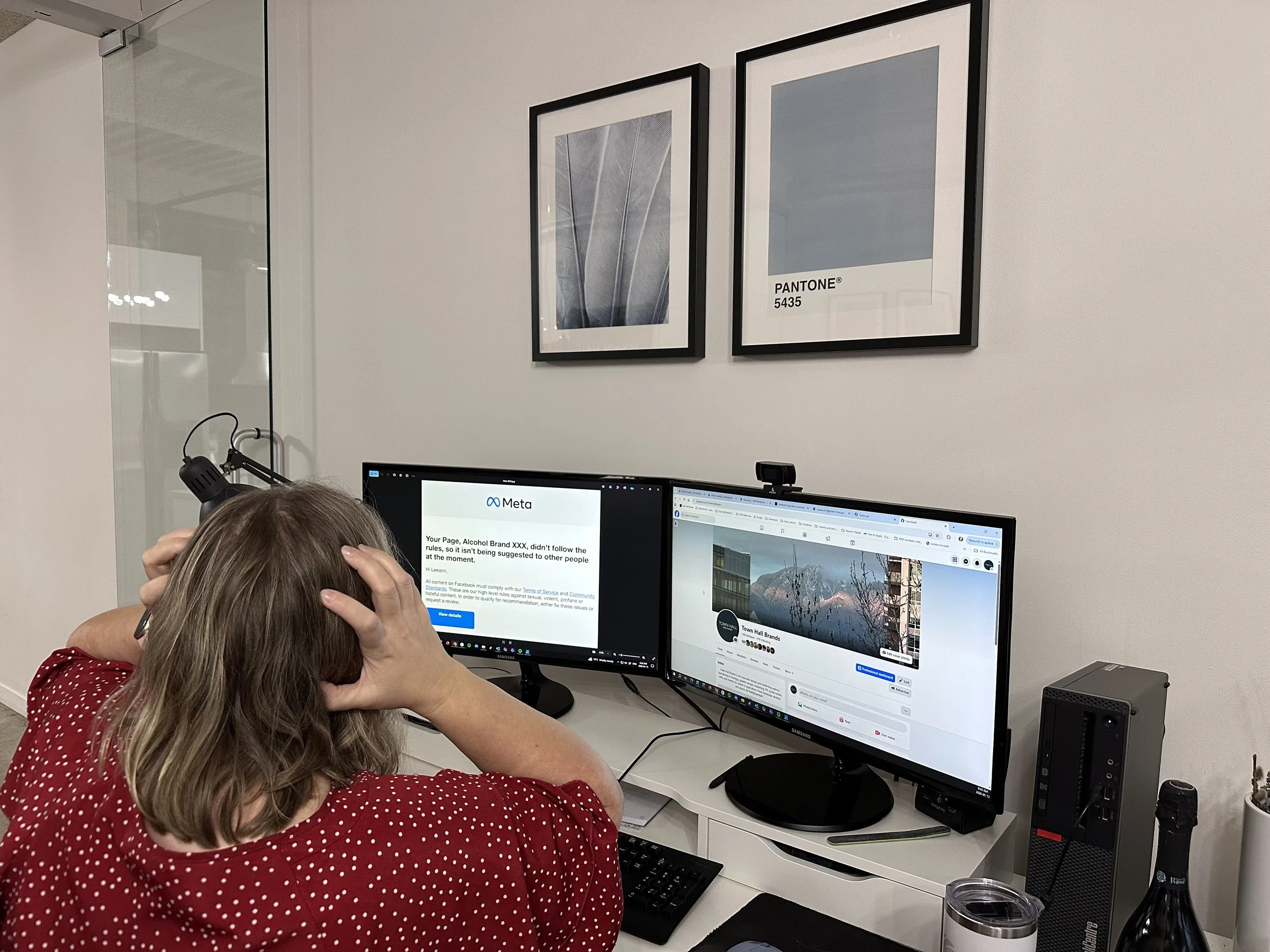
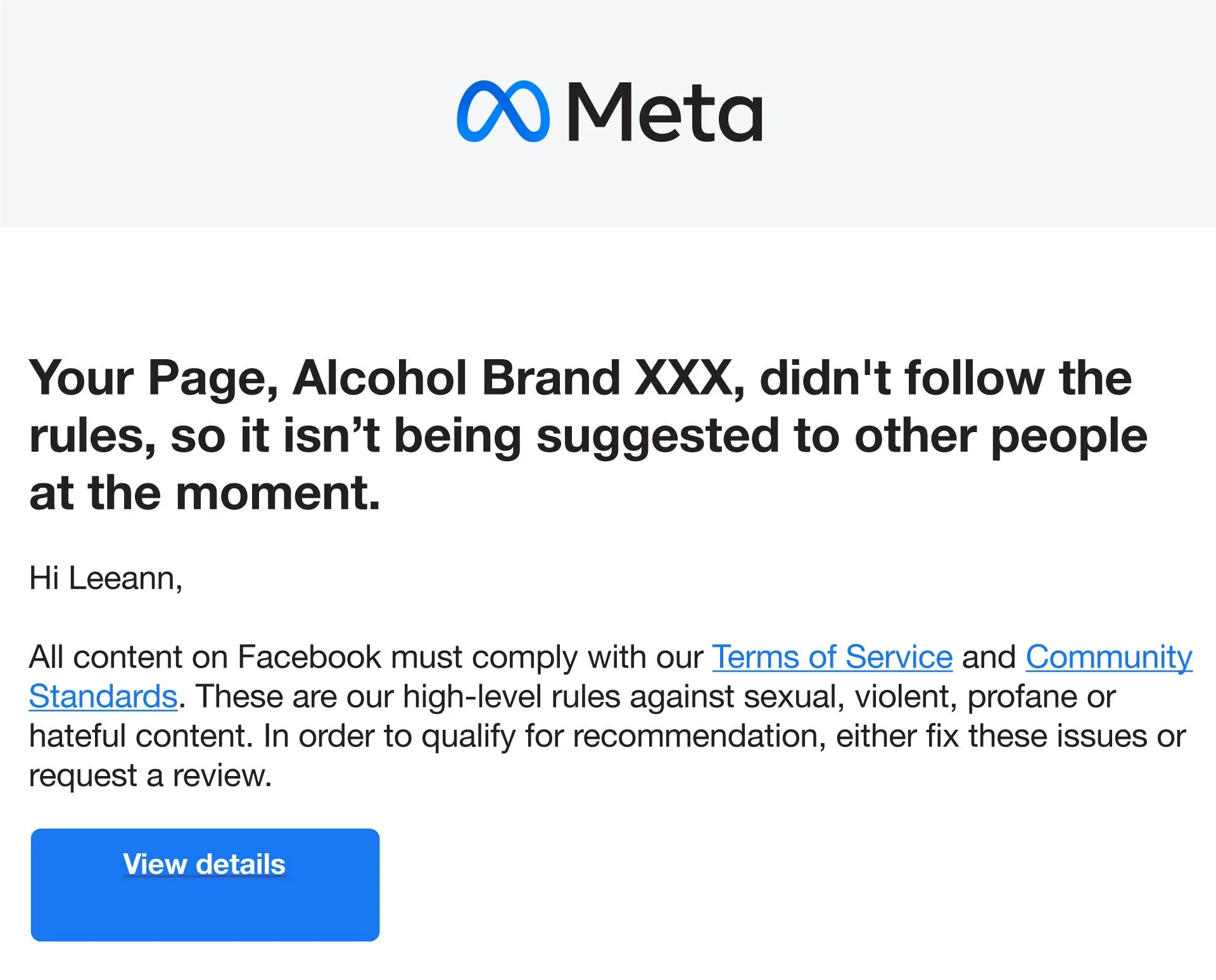
In recent weeks, wineries, breweries, and distilleries have begun receiving an unsettling notification from Facebook:
“Your Page didn’t follow the rules, so it isn’t being suggested to other people at the moment.”
The message goes on to reference Facebook’s Terms of Service and Community Standards, citing high-level rules around sexual, violent, profane, or hateful content, and offers the option to “fix these issues or request a review.”
For many wineries, this has been confusing. Pages remain live. Content appears compliant. Page Status often shows no violations at all. Yet discovery has narrowed.
This is not a crisis.
But it is an important signal.
This is not a takedown or a clear violation
What wineries are encountering is not the same as content removal or account suspension.
Facebook’s Community Standards determine what content is *allowed to exist* on the platform. Most wineries are fully compliant and remain in good standing. What has changed is *recommendation eligibility*, which Facebook controls separately and can adjust at any time under its Terms of Service.
In short, a page can follow every rule and still be excluded from recommendation.
That distinction matters, because it explains why the notice feels vague and why Facebook often cannot (or will not) point to a single offending post.
Why Facebook doesn’t tell you exactly what’s wrong
Facebook’s recommendation systems rely heavily on automation and pattern recognition. The trigger may not be one obvious issue, but a combination of factors such as:
Historical posts, not recent ones
Language that could be interpreted as suggestive, profane, or promoting overconsumption
Imagery implying partying or excessive drinking
Unmoderated comments from followers
Context that an algorithm cannot clearly interpret
Even content from years ago can affect recommendation eligibility today.
As frustrating as it is, this lack of specificity is intentional. Platforms do not disclose precise triggers because doing so would allow the system to be gamed.
What alcohol companies can realistically do if they receive this notice
There *are* practical steps wineries can take, even if the outcome is not guaranteed.
Before requesting a review, wineries should:
Audit recent and historical posts for borderline language or imagery
Remove or archive anything that relies on innuendo, sexual humour, or “party” framing
Review imagery for cues that could imply overconsumption or underage audiences
Ensure Facebook Page category, description, and age restrictions are accurate
Moderate comments more aggressively, as user comments are considered part of Facebook Page content
Only after cleaning up anything questionable should a winery request a review, understanding that:
Feedback may be limited or nonexistent
Approval does not guarantee long-term recommendation
Many compliant alcohol pages are being broadly deprioritized regardless
This is not about punishment. It is about risk management on the platform’s side.
The bigger issue: you do not own social media
At Town Hall Brands, we have long advised that the most important assets a winery can build are its website and its email list.
Social platforms are powerful tools, but they are “rented” spaces and in the case of Facebook, Meta is the landlord. Algorithms change. Policies tighten. Categories like alcohol are treated conservatively. Pages can lose visibility overnight with little explanation and limited recourse.
If a Meta account were to disappear tomorrow, a winery with a strong website, a healthy email list, and an established media footprint would still be standing. A winery that built its entire audience inside a platform would not.
That reality has not changed. What has changed is how clearly it is now being demonstrated.
What this means for BC winery marketing in Winter 2026
This moment intersects directly with broader shifts already shaping the BC wine industry, that we have written about before.
Storytelling must shift from scarcity to optimism.
Discovery is narrowing, so the stories that do travel must be confident, unified, and forward-looking. Earned media, websites, and email are ideal channels for reinforcing the message that BC wine is resilient, collaborative, and producing exceptional quality.
Digital presence matters more than tasting room design.
This now means conversion infrastructure, not just social aesthetics. Your website must work harder. Social content should move people *off platform*, not act as the destination.
Micro experiences outperform grand ones.
Smaller, accessible experiences are easier to share, easier to pitch, and easier to repeat. They also travel better through PR, partnerships, and newsletters than through algorithms alone.
Tourism patterns are shifting.
With stronger shoulder seasons and more regional travel, discovery increasingly happens through search, media, and destination platforms rather than social feeds.
Collaboration is now a competitive advantage.
When individual pages are harder to discover, regional storytelling becomes more powerful. Media prefers clusters. Guests respond to cohesion.
Planning cannot happen during harvest and production.
Winter 2025 to spring 2026 is the critical window to reassess channel dependency, rebuild foundations, and plan content and PR with intention.
The renewed importance of PR and earned media
One of the most important implications of Meta’s shift is the renewed role of earned media.
PR is not affected by recommendation limits or algorithm changes. Media coverage is searchable, permanent, and compounding. It lives on your website. It feeds Google and generative AI discovery. It builds credibility in ways social platforms cannot suppress.
As social discovery becomes less dependable for alcohol brands, earned media once again functions as a primary visibility channel, not a secondary one.
An important nuance worth noting
Based on industry feedback and anecdotal reports from wineries actively spending on Meta, this change appears to affect organic Page recommendations only, not the delivery or performance of paid advertising.
Compliant alcohol ads continue to run as expected, with normal targeting, impressions, and results.
This suggests Meta is separating organic endorsement and discovery from paid, controlled reach.
In practical terms, Facebook may be saying it will allow compliant alcohol brands to advertise, but will be more conservative about recommending them algorithmically.
This distinction reinforces the need to treat organic social as a communication channel, paid social as a tactical tool, and owned and earned channels as the foundation of long-term visibility.
A strategic reset, not a setback
This is not a signal to abandon social media. It is a signal to stop building businesses as if social media were guaranteed.
The wineries that will thrive in 2026 are the ones that rebalance now. They will invest in owned channels, strengthen their media footprint, collaborate regionally, and treat platforms as tools rather than foundations.
Algorithms will continue to change.
Policies will continue to tighten.
Platforms will continue to prioritize their own interests.
Your job is to make sure your brand is not dependent on any one of them.
Does reading this give you anxiety and overwhelm? We are here to help. We have been marketing in beverage alcohol for more than two decades, and we have a team that can help you navigate all levels of media needs.